
Overview
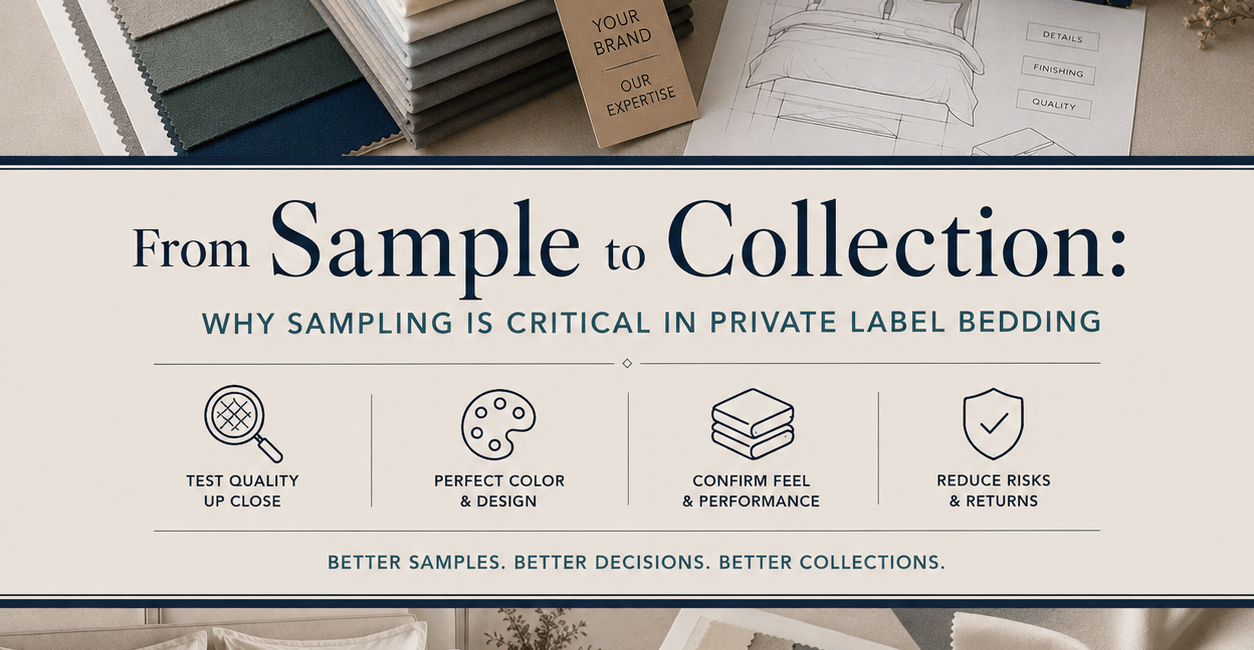
In premium bedding, a sample is much more than a piece of fabric or a prototype waiting for approval.
It is where an idea begins to become a product.
For brands developing private label collections, the sampling stage is one of the most valuable opportunities to evaluate materials, refine details, test assumptions and make important decisions before committing to production.
It is also the first real test of the relationship between a brand and its manufacturing partner.
How accurately does the manufacturer interpret the brief? How quickly can alternatives be proposed? Are technical limitations identified early? Can creative ideas be translated into a product that is both beautiful and commercially viable?
A well-managed sampling process does not simply confirm a product. It helps create a better one.
A Sample Should Answer Questions, Not Just Look Good
The immediate reaction to a bedding sample is naturally visual and tactile.
Does it look right? Does it feel right?
But for a professional buyer, the questions should go much further.
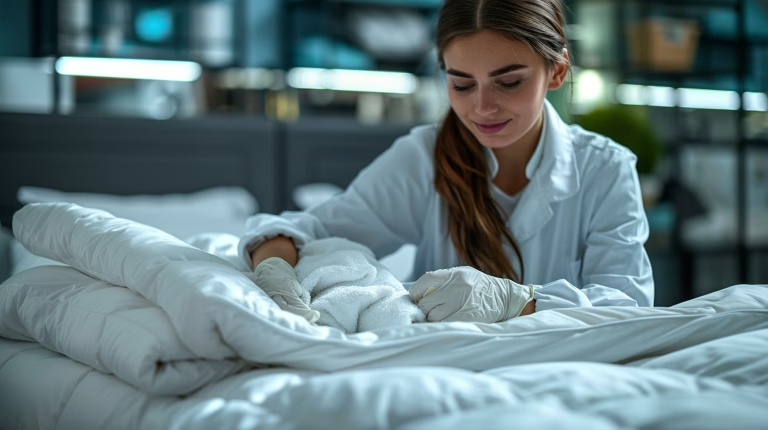
A useful sample should help evaluate:
- fabric construction
- weight and handle
- colour accuracy
- stitching quality
- dimensions and proportions
- finishing details
- overall product appearance
Touch Cannot Be Fully Evaluated on a Screen
Digital product development has made international collaboration dramatically easier.
Technical specifications, colour references, drawings and high-resolution images can travel around the world instantly.
But bedding remains an intensely tactile product.
A specification sheet cannot fully communicate the crispness of a percale, the fluidity of a sateen, the quality of an embroidery or the way a finished product feels in the hand.
For premium collections, these sensory differences matter.
Physical sampling allows buyers and designers to compare alternatives and make decisions based on the actual product rather than assumptions.

The First Sample Does Not Have to Be the Final Product
One of the most valuable aspects of sampling is the possibility of iteration.
The first sample may reveal that:
- a colour needs adjustment
- an embroidery should be more subtle
- a border needs different proportions
- another fabric construction would work better
- a finishing detail should be simplified
- the overall product needs a different balance
Sampling Should Test Performance, Not Just Appearance
Premium bedding has to perform as well as it looks.
Depending on the product and its intended market, the sampling and approval process may also need to consider characteristics such as:
- dimensional stability
- shrinkage
- colour fastness
- seam performance
- fabric behaviour after washing
- consistency of finishing
Good Sampling Can Prevent Expensive Production Mistakes
Changes are relatively easy during development.
They become much more complicated once production begins.
An incorrectly interpreted detail, unsuitable fabric or poorly defined construction can affect an entire production run.
The financial consequences can extend well beyond manufacturing itself, potentially affecting:
- launch dates
- inventory
- packaging
- logistics
- retail commitments
- customer satisfaction
Samples Also Allow You to Evaluate the Manufacturer
Sampling does not only test the product.
It tests the partnership.
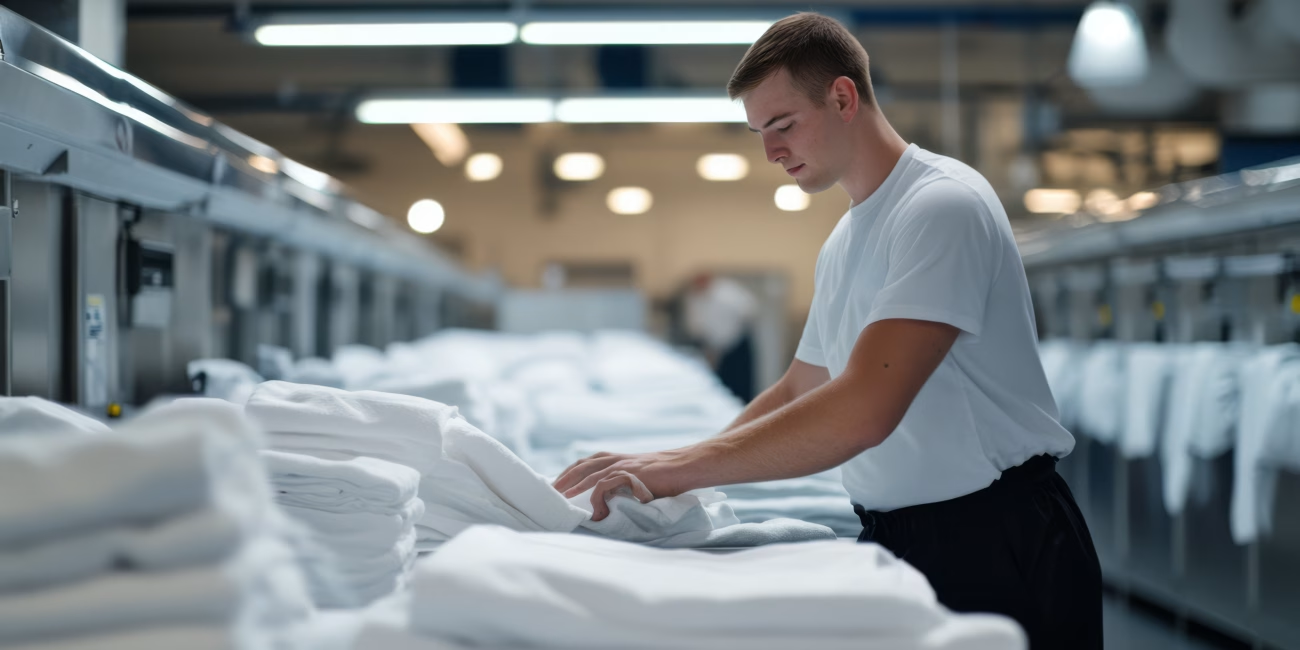
The development stage reveals a great deal about how a manufacturer works.
Does the team understand the creative brief? Do they ask the right questions? Can they identify potential problems before they become expensive ones? Can they suggest better technical solutions? How do they respond when something needs to change?
For a brand looking for a long-term private label partner, these signals can be just as important as the sample itself.
A technically capable manufacturer should not merely reproduce instructions. It should contribute knowledge to the development process.
The Best Samples Bring Design and Manufacturing Together
Successful private label bedding requires a balance between creative ambition and manufacturing expertise.
Designers and brands bring the vision.
Manufacturers bring knowledge of fibres, fabrics, constructions, finishing techniques and production processes.
Sampling is where those two worlds meet.
When the relationship works properly, the process becomes collaborative: ideas are tested, alternatives explored and details refined until the product reflects the original creative intention while remaining technically sound and commercially viable.
That is when a sample stops being a prototype and starts becoming a collection.
Conclusion
In private label bedding, sampling should never be considered a formality between design and production.
It is one of the most important stages of product development.
It allows brands to experience the product, refine creative decisions, evaluate performance, reduce production risk and, just as importantly, discover how their potential manufacturing partner approaches challenges and collaboration.
At ACL Impex, we see sampling as the beginning of that partnership. Our technical and creative teams work alongside clients to explore materials, constructions, colours, finishes and manufacturing solutions before moving towards production.
Because the objective is not simply to produce the sample that was requested.
It is to help develop the right product.
Have a bedding concept in development? Request samples and explore how ACL Impex can help turn your idea into a distinctive private label collection.